

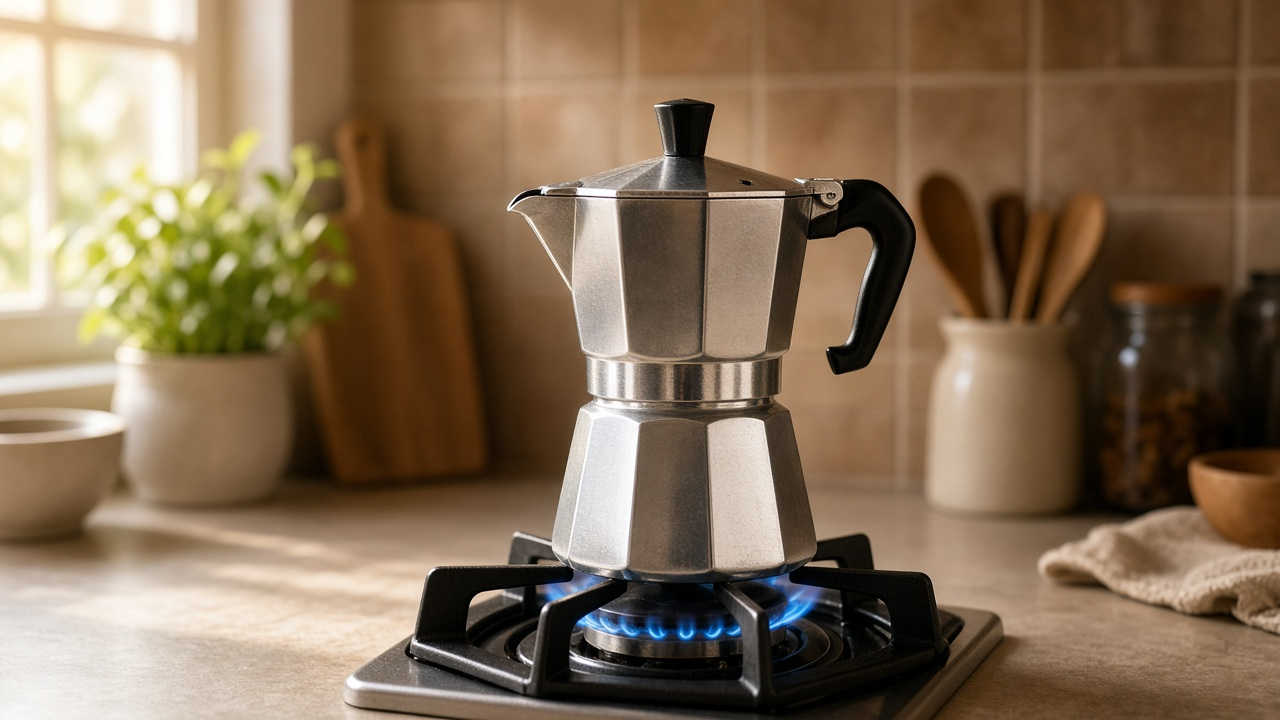
A tea and coffee corner in a small space works best when coffee sets the layout and tea fits around it. Coffee needs the most gear: a brewer, beans or ground coffee, and hot water. Tea mostly needs hot water and a place for the leaves or bags. Build around the coffee kit, then give tea one shelf, one basket and the same kettle.
Pinterest’s 2026 Hobbies Trend Report says the “coffee brewing aesthetic” is up 160% and that “the look, process and setup are now part of the appeal.” The nine ideas below are for a counter end, a cupboard or a single shelf, with coffee first in every one.
Some links in this post are affiliate links, so if you buy through one we may earn a small commission at no extra cost to you. As an Amazon Associate I earn from qualifying purchases.
The Quick Answer: Coffee Leads, Tea Follows
- One heat source for both drinks. One kettle heats water for the coffee brewer and the teapot or mug.
- One compact coffee brewer. Pick a brewer you can put away, so the counter stays clear between cups.
- Tea in one container, in one spot. Keep tea in a closed box or tin, separate from the coffee.
- Beans in an opaque, airtight canister. Keep it away from heat and strong sun.
Planning a full coffee bar with an espresso machine? Our home coffee bar layout guide covers outlets, circuits and spacing. This post is about much less room.
Start With the Kettle: One Heat Source for Both Drinks
The kettle is the one appliance coffee and tea share, so choose it first. The two drinks want different water temperatures. The Coffee Association of Canada says a brewer should keep water between 195 and 205 °F (about 90 to 96 °C). The UK Tea & Infusions Association gives 90 to 98 °C for black tea and around 80 °C for green tea.
1. A temperature-control kettle as the anchor
A kettle with temperature settings covers both ranges, so a small counter needs only one. The Cosori gooseneck electric kettle holds 0.8 liters. Cosori lists five presets: white tea (170 °F), green tea (180 °F), oolong (195 °F), coffee (205 °F) and boil (212 °F). Its gooseneck spout also gives the pour control described in idea 2, so one kettle covers both.
Coffee first: set the kettle to your coffee temperature for the morning brew. Tea add-on: change the setting for a green tea later in the day.
2. A gooseneck kettle if pour-over is your daily cup
If you brew pour-over every morning, a gooseneck spout gives you more control over where the water lands. In an r/Coffee thread about limited kitchen space, one reply suggests using the gooseneck for everything instead of keeping two kettles. It can fill a teapot or mug too, so one kettle still does both jobs.

Coffee first: keep the gooseneck next to the dripper. Tea add-on: the same kettle fills the teapot.
Choose a Coffee Brewer That Packs Away
In a small corner, a brewer you can put away matters more than extra features.
3. An AeroPress that lives in the cupboard
The AeroPress Original is a manual press. The listing gives its assembled size as 9 1/2 inches tall and 4 inches wide and deep, and says one pressing brews one to three servings. It is made from BPA-free Tritan, and the listing describes it as compact, lightweight and shatterproof.
Coffee first: brew in the AeroPress, then put it back in the cupboard. Tea add-on: the counter space it frees can hold the tea box.
4. Pour-over cones that stack with the mugs
A cone dripper sits right on the mug, so pour-over gear can share space with your cups. Stack the drippers on the mugs you use daily and keep filters in a drawer below.

Coffee first: the dripper you use most goes on top of the stack. Tea add-on: a mug with no dripper on it is ready for tea.
Make Room for Tea Without a Second Station
Tea doesn’t need its own station: one brewing tool and one storage spot next to the coffee are enough.
5. A mesh brewing basket for loose tea
A basket that sits in the mug means you don’t need a teapot for one cup. The Finum Brewing Basket (medium) is stainless-steel micro-mesh in a heat-tolerant, BPA-free frame. The listing says it works for tea, coffee and herbs, is dishwasher safe, and has a lid that flips over to become a drip tray.

Coffee first: the basket lives on the coffee shelf, next to the mugs. Tea add-on: steep for the time on the pack, then lift it out onto its lid.
6. One shelf: coffee at the front, tea behind
On a single shelf, put what you use most at the front: beans, filters and the brewer, with tea one row back. If tea is your afternoon drink, swap the rows after lunch instead of adding a shelf.
Coffee first: the morning kit is the first thing you reach. Tea add-on: one tea box behind it, not a row of open packets.
Store Beans and Leaves the Right Way
Coffee and tea both pick up smells, so storage is where a shared corner can go wrong.
7. An opaque canister for coffee beans
The National Coffee Association recommends an airtight, opaque container in a dark, cool place. It says to avoid cabinets near the oven or dishwasher and spots that get strong afternoon sun. It notes that clear canisters let in light. The Coffee Gator stainless steel canister (16 oz) has a stainless-steel body that the listing says keeps light and moisture out, a one-way CO2-release valve, a date wheel for the purchase or expiry date, and a measuring scoop. The listing says to wash it by hand. Buying pre-ground? Our guide to coffee grinder types explains the options.
Coffee first: the canister sits at the front of the shelf. Tea add-on: the listing also names tea as a use, so a second canister works for loose leaf.
8. Tea in its own closed box, away from strong smells
The UK Tea & Infusions Association says to store tea in a cool, dry place and not next to strongly flavored or perfumed foods. The National Coffee Association says coffee absorbs moisture, odors and tastes from the air around it. Our suggestion is to keep the two in separate closed containers, and to keep spices and scented candles out of the corner.
Coffee first: coffee keeps its sealed canister. Tea add-on: tea gets a lidded box or tin of its own, on the same shelf.
Find a Corner You Already Have
9. A counter end or cupboard close to an outlet
Pick a spot near an outlet and the sink, so filling the kettle is easy. A sunny windowsill looks good, but the National Coffee Association’s advice on strong sun means the beans belong elsewhere. If counter space is the problem, our older coffee station guide for tiny kitchens has wall-mounted and under-cabinet ideas. For a chair-side setup, see our reading nook coffee corner ideas.
Coffee first: the brewer or machine sits closest to the outlet. Tea add-on: the teapot and tea canister sit to one side, within reach of the kettle.
Tea and Coffee Corner Cheat Sheet
Keep this next to the kettle. Always check the instructions on the coffee or tea pack.

FAQ
Can I use the same kettle for coffee and tea?
Yes. A kettle with temperature control makes the different ranges easy: about 90 to 96 °C for coffee, 90 to 98 °C for black tea and around 80 °C for green tea.
Can I store coffee and tea together?
Keep them on the same shelf, but in separate closed containers. Coffee absorbs odors from the air around it, and the UK Tea & Infusions Association advises keeping tea away from strongly flavored foods.
How do I set up a tea and coffee station in a small kitchen?
Start with one kettle and one compact coffee brewer near an outlet. Add one closed tea container and one mesh basket, and store anything you don’t use daily in a cupboard.
What water temperature should I use for green tea?
The UK Tea & Infusions Association gives around 80 °C, and says to read the instructions on the pack.
Wrap-Up
A small tea and coffee corner works when coffee sets the layout: one kettle, one brewer that packs away and one opaque canister. Then fit tea in with a basket and a closed box. For color ideas, see our café kitchen color palettes.
Featured photo: Seljan Salimova / Pexels
Sources
- Pinterest Newsroom, “Pinterest Hobbies Trend Report 2026” (Home Café Engineering): https://newsroom.pinterest.com/news/2026-pinterest-hobbies-trend-report/
- Coffee Association of Canada, “From Seed to Cup” (brewer water temperature between 195 and 205 °F): https://coffeeassoc.com/supply-chain/seed-to-cup/
- National Coffee Association, “Storage and shelf life” (airtight, opaque container; avoid heat and strong sun; coffee absorbs odors): https://www.aboutcoffee.org/beans/storage-and-shelf-life/
- National Coffee Association, “French press coffee” (brewing temperature 93 ± 3 °C): https://www.aboutcoffee.org/brewing/french-press-coffee/
- UK Tea & Infusions Association, “How to make a perfect brew” (black tea 90 to 98 °C, green tea around 80 °C; tea storage): https://www.tea.co.uk/make-a-perfect-brew
- r/Coffee, “Limited kitchen space – gooseneck kettle?”: https://www.reddit.com/r/Coffee/comments/i666rt/limited_kitchen_space_gooseneck_kettle/
- COSORI, Original Electric Gooseneck Kettle (CO108-NK) product page (5 presets: white 170 °F, green 180 °F, oolong 195 °F, coffee 205 °F, boil 212 °F; 0.8 L): https://cosori.com/products/electric-gooseneck-kettle-co108-nk
- Amazon.com product listings for the four products linked above (specs as stated on the listings, checked 2026-11-13).
- Photos: Seljan Salimova (https://www.pexels.com/photo/32206208/, featured photo), Cup of Couple (https://www.pexels.com/photo/7658089/), Elena Golovchenko (https://www.pexels.com/photo/28853826/), Jacek Jan Skorupski (https://www.pexels.com/photo/5567570/), all via Pexels under the Pexels License.
Leave a Reply