
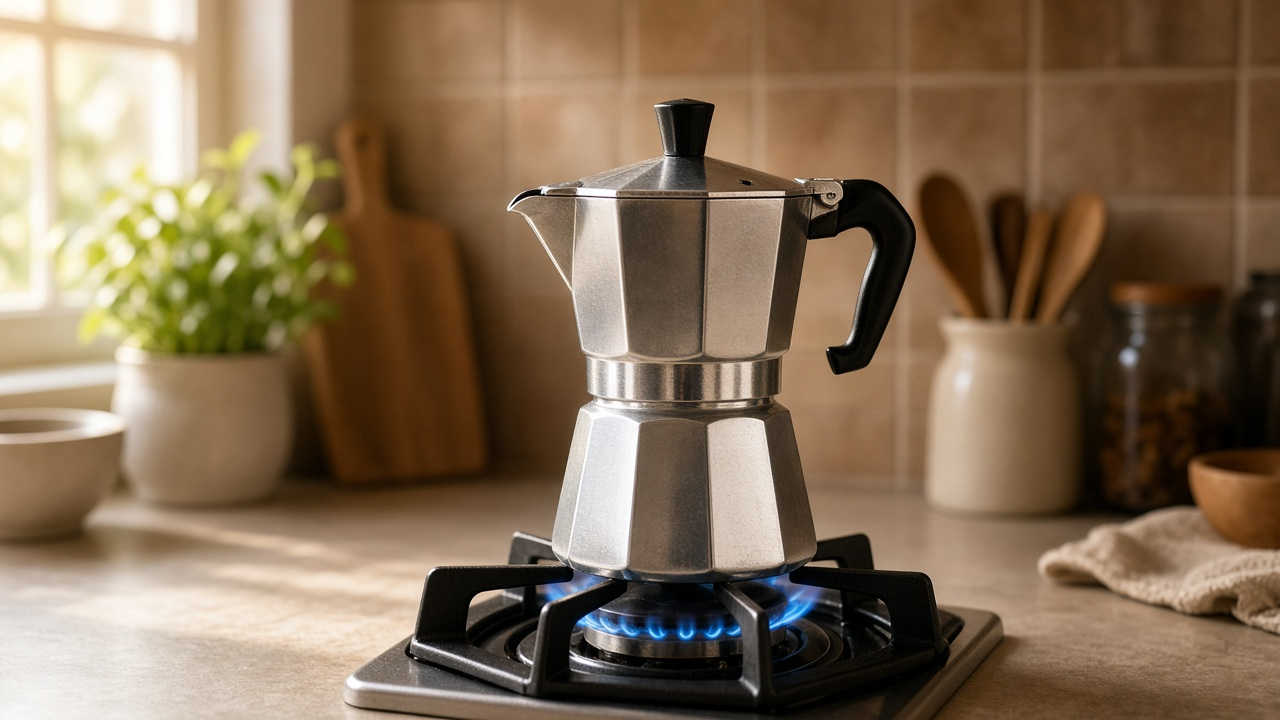
A moka pot makes strong, concentrated coffee on the stove with nothing more than water, ground coffee and gentle heat. Learning how to use a moka pot comes down to four things: water to the valve, a medium-fine grind you never tamp, low to medium heat, and taking it off the burner the moment it starts to gurgle.
This guide walks through every step, fixes the three most common problems (bitter, weak and sputtering coffee), covers cleaning, and ends with how to choose a moka pot for your stove.
Some links in this post are affiliate links, so if you buy through one we may earn a small commission at no extra cost to you. As an Amazon Associate I earn from qualifying purchases.
The Quick Answer
- Water: fill the bottom chamber up to the lower edge of the safety valve, never above it.
- Coffee: fill the funnel with medium-fine ground coffee, level it, wipe the rim, and don’t press it down.
- Heat: low to medium. On gas, keep the flame under the base.
- Done: when you hear a gurgle or hiss, take it off the heat, stir the coffee and pour.
What Is a Moka Pot?
A moka pot is a three-part stovetop brewer: a bottom chamber (the boiler) for water, a funnel-shaped basket for the coffee and a top chamber that collects the brewed coffee. As the water heats, pressure pushes it up through the grounds and into the top. Alfonso Bialetti invented the design in 1933, and the eight-sided Moka Express is still the shape most people picture.
Is it espresso? Not quite. Blue Bottle Coffee calls it “espresso-style” coffee: strong and rich, made without an espresso machine. That makes it a great base for milk drinks, and every recipe in our holiday lattes guide works with moka pot coffee. If you also pull shots on a machine, our guide to dialing in espresso at home covers the machine side.
How to Use a Moka Pot, Step by Step
First time? Bialetti’s manual says to wash a new pot with water, then brew at least 3 pots of coffee and pour them away. Those first brews season the pot.
- Fill the bottom chamber with water. Fill to the lower edge of the safety valve. Bialetti’s manual says cold water, and its website says room-temperature. Blue Bottle notes that starting with hot water speeds up brewing; if you do, handle the hot base with a towel or potholder.
- Insert the funnel. If water comes up into the funnel, pour it out and put the funnel back.
- Add the coffee. Fill the funnel generously with medium-fine ground coffee and level it gently. Do not tamp. Wipe loose grounds off the rim so the pot seals. For a 6-cup pot, Blue Bottle uses about 20 to 22 g of coffee.
- Screw the top on firmly. Twist by the body, not the handle. Bialetti warns against forcing the handle.
- Heat low to medium. Keep a gas flame from reaching past the edge of the base. On electric or glass-ceramic hobs, Bialetti says not to use the highest setting.
- Watch and listen. Coffee starts to flow into the top chamber. Bialetti’s New Zealand guide says brewing takes about 3 to 6 minutes, depending on the pot size and the heat. Keep the lid closed while it brews.
- Take it off at the gurgle. When the top is full and you hear a gurgle or hiss, take the pot off the heat right away.
- Stir and pour. Stir the coffee in the top chamber, as Bialetti’s manual advises, then pour with a potholder. Bialetti recommends drinking it right away.

Grind, Water and Heat: Get These Right
Grind: medium-fine, not espresso-fine
Moka pots need a grind between pour-over and espresso. Blue Bottle compares it to granulated sugar. Bialetti’s New Zealand guide says it should feel gritty, not powdery, when rubbed between your fingers. Bialetti also says pre-ground coffee sold for espresso machines is usually too fine and can block the pot.
If you buy pre-ground coffee, look for “moka” or ask your roaster for a moka grind. If you grind at home, a burr grinder gives you a more even grind and lets you adjust it. Our coffee grinder types guide explains burr vs blade grinders and manual vs electric.

Water: to the valve, never above
Bialetti says the water should reach the lower edge of the safety valve. Fill above it and Bialetti warns the coffee will be too watery. Its New Zealand guide adds that overfilling leaves too little air space, and the coffee can end up boiled, bitter or burnt.
Heat: low and patient
Bialetti’s tip is to set the flame low and be patient, and Blue Bottle uses medium heat. Bialetti’s New Zealand guide warns that full heat can give the coffee a burnt taste.
Gas, electric or induction?
Bialetti’s New Zealand guide says its aluminum and stainless pots work on gas, electric and ceramic hobs, and its stainless steel models also work on induction. Check your hob’s manual to make sure the pot’s base is big enough for it. On induction, stick to low or medium, because a high setting can overheat the pot quickly.
Moka Pot Troubleshooting
Bitter or burnt coffee
- Heat too high. Turn it down. r/Coffee commenters link extra bitterness to high heat and steam going through the coffee.
- Left on too long. Pull the pot off at the first gurgle. One r/Coffee commenter notes that the sputtered last part of the brew is the most bitter.
- Too much water. Fill only to the lower edge of the valve.
Weak, sour or watery coffee
- Funnel not full. Fill it generously and level it.
- Grind too coarse. Go a step finer, stopping short of espresso-fine. In one r/Coffee thread about a sour, salty cup, the advice was to try a finer grind.
- Water above the valve. Bialetti says overfilling makes the coffee too watery.
Sputtering
A little sputter right at the end is normal: it’s your cue that brewing is done. Sputtering from the start usually means the heat is too high. One r/Coffee commenter suggests the smallest burner on its lowest setting. If steam or water escapes around the middle seam, the pot is probably leaking: tighten it, wipe grounds off the rim and check the gasket.
No coffee, or the safety valve hisses
If the safety valve vents, Bialetti’s manual says to check that the coffee is a moka grind, that it isn’t pressed into the funnel and that there isn’t too much water. If no coffee comes up, it says to check that all parts are in place, that the pot is screwed on tightly and that it isn’t leaking. If the valve keeps venting, stop using the pot and contact the seller or maker.

How to Clean a Moka Pot
- Let it cool first. Bialetti says to wait until the pot has cooled before opening or cleaning it.
- Rinse with warm water. No detergent, no abrasive sponge and no dishwasher. Bialetti says dishwashers can damage the pot and change the taste of the coffee.
- Dry and store it open. Let every part dry fully and store the pot unscrewed.
- Keep the holes clear. Check the filter plate for blocked holes and clear them with a soft brush or needle.
- Replace the gasket. Replace it when it’s worn, and at least once a year anyway, using original parts for your model.
- Descale now and then. Bialetti’s method: fill the bottom with water, add two teaspoons of citric acid or vinegar, run one brew with no coffee, throw it away, rinse and then brew coffee.
Which Moka Pot to Buy
Moka pot sizes are counted in espresso cups (small servings), not mugs. The pot is filled to the valve and the funnel is filled each time, so choose the size that matches how much coffee you usually make.
- The classic: Bialetti Moka Express. The Bialetti Moka Express has an octagonal aluminum body. Bialetti lists it for gas and electric hobs, and for induction only with the Bialetti induction plate. The listing says it’s made in Italy. Rinse it with water only.
- Stainless steel for induction: Bialetti Venus. The Bialetti Venus is 18/10 stainless steel. Bialetti lists it for electric, gas and induction hobs, except the 2-cup size. It’s not dishwasher safe.
- A hybrid for induction: GROSCHE Milano Induction. The GROSCHE Milano Induction has an aluminum upper chamber and a stainless steel bottom chamber, and GROSCHE says it works on all stovetops, including induction. GROSCHE lists a safety valve and a burn guard on the handle. Hand wash only.
- A grinder for a fresh moka grind: TIMEMORE Chestnut C3S. The TIMEMORE Chestnut C3S is a hand grinder with an all-metal aluminum body and stainless steel conical burrs. TIMEMORE says the C3s adjusts from espresso-fine to French press coarse, and moka grind sits between the two. Clean it with the brush, not water.
Need a spot for the pot, grinder and cups? Our home coffee bar layout guide covers workflow order and spacing.
FAQ
How do you know when a moka pot is done?
When the top chamber is full and you hear a gurgle or hiss, it’s done. Take it off the heat right away. Bialetti says the coffee is ready when it starts to gurgle.
Do you tamp coffee in a moka pot?
No. Bialetti says never to press the coffee into the funnel. Fill it, level it and wipe the rim.
What grind size is best for a moka pot?
Medium-fine, about like granulated sugar: finer than pour-over, coarser than espresso. Espresso-machine grinds are usually too fine.
Can you use a moka pot on an induction stove?
Yes, with an induction-ready pot such as the Bialetti Venus (all sizes except the 2-cup) or the GROSCHE Milano Induction. An aluminum Moka Express needs Bialetti’s induction plate.
Can I put my moka pot in the dishwasher?
Bialetti says no for the Moka Express and the Venus, and GROSCHE says the Milano Induction isn’t dishwasher safe. Rinse with warm water and let it dry open.
Wrap-Up
A great moka pot cup is simple once the basics click: water to the valve, a full funnel of medium-fine coffee, gentle heat, and off the burner at the gurgle. Start there, adjust the grind or heat if the cup tastes bitter or weak, and turn your stovetop coffee into lattes with our dessert lattes guide.
Sources
- Bialetti, Moka Express product page, “How to use” and “Cleaning instructions” (room-temperature water up to the safety valve; Moka grind, not too fine; fill the funnel without pressing; low heat; coffee ready at the gurgle; rinse with water only, no detergents, not dishwasher safe; aluminum body; induction only with the Bialetti induction plate): https://www.bialetti.com/it_en/moka-express.html
- Bialetti, Moka Express instruction manual, ed. 01/2021, English section (cold water to the lower edge of the valve; first 3 brews discarded; never press coffee; flame not beyond the rim; not the highest setting on electric; stir before pouring; cool before opening; no detergents or dishwasher; dry and store open; replace the gasket at least once a year; descaling with citric acid or vinegar; safety-valve FAQ): https://www.bialetti.com/media/manual/caffettiere/Moka_Express_ed_01_2021_0103102.pdf
- Bialetti, Venus product page (18/10 stainless steel; electric, gas and induction hobs except the 2-cup; not dishwasher safe; rinse with water only): https://www.bialetti.com/it_en/venus.html
- Bialetti New Zealand, “Using Bialetti Coffee Makers” (medium-fine grind that feels gritty, not powdery; espresso-machine grind too fine; overfilling gives bitter or burnt coffee; low to medium heat, especially on induction; 3 to 6 minutes; stainless models work on induction): https://www.bialetti.co.nz/blogs/making-great-coffee/using-bialetti-coffee-makers
- Blue Bottle Coffee, “How to Make Moka Pot Coffee” (invented by Alfonso Bialetti in 1933; espresso-style coffee; 20 to 22 g for a 6-cup pot; grind like granulated sugar; hot water speeds up brewing; don’t tamp; medium heat; flame smaller than the base): https://bluebottlecoffee.com/us/eng/brew-guides/moka-pot
- GROSCHE, Milano Induction product page (aluminum upper chamber, stainless steel bottom chamber; all stovetops including induction; safety valve and burn guard; not dishwasher safe): https://grosche.ca/products/milano-induction-stovetop-espresso-maker-moka-pot-3-cup
- TIMEMORE, Chestnut C3s product page (all-metal unibody; stainless steel burrs; espresso to French press range): https://www.timemore.com/products/timemore-chestnut-c3s-jet-black
- r/Coffee threads: “Moka pot sputtering when using boiling water” https://www.reddit.com/r/Coffee/comments/101fljx/moka_pot_sputtering_when_using_boiling_water/ ; “Need help fixing moka pot brewing” https://www.reddit.com/r/Coffee/comments/1h08k0m/need_help_fixing_moka_pot_brewing_it_sputters_and/ ; “Mokka Pot – How It’s Going…” https://www.reddit.com/r/Coffee/comments/wbg8tl/mokka_pot_how_its_going/ ; “Moka Pot- Bitter and salty brew” https://www.reddit.com/r/Coffee/comments/2tuk2p/moka_pot_bitter_and_salty_brew_makes_you_pucker/ ; “Very sour taste with moka pot” https://www.reddit.com/r/Coffee/comments/x6fciq/very_sour_taste_with_moka_pot/
- Amazon.com product listings for the four products named above (details as stated on the listings, checked 2026-11-24).


Leave a Reply